
Budget for 2022-2023 has returned to its agenda for protectionism in the name of creating a self-reliant India, points out A K Bhattacharya.
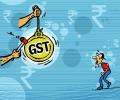
The broad trends of GST collections will make you wonder if indeed the biggest indirect tax reform in the country has led to a real improvement in revenues, notes A K Bhattacharya.

The challenges before the coming Budget are more daunting than those in 2021, reveals A K Bhattacharya.

India's traditional companies are now moving full scale into the renewable and alternative energy space that had been dominated by smaller players over the past decade. Companies such as government-owned NTPC and the Adani and the Tata groups restructured their businesses well in time to become major players in the green space. At the same time, other conventional companies, such as Larsen & Toubro and Reliance Industries Ltd (RIL), which have a presence both in the energy sector as well as myriad other activities - construction, technology and retailing - are tying up with new-age companies to hitch a ride to a greener path.

If the Centre and states are keen on spending more to meet the COVID-19 challenges in the coming year, they must bear in mind the need to raise more resources through taxes and non-tax revenues, suggests A K Bhattacharya.

Tata Group is in discussions with some major international companies, including those from Taiwan, for its foray into the semiconductor chip business. The Union government had earlier tried to bring in Taiwanese manufacturers Taiwan Semiconductor Manufacturing Company (TSMC) and United Microelectronics Corporation (UMC) for chip manufacturing in India. A person close to the development said the Tatas have now opened a separate channel for a possible tie-up. Currently, India mostly imports chips, which are fabricated and assembled to put into various applications, including automobiles, renewable power, mobile phones, televisions, and other electronic items.

The finance minister could well be on her way to setting a record of achieving the biggest single-year reduction in the government's fiscal deficit, explains A K Bhattacharya.

The Centre's retreat from the farm laws is likely to have a significant bearing on the fate of laws that the Centre has made, for instance, in labour and electricity, predicts A K Bhattacharya.

There is no reason for keeping an entire ministry with a total staff strength of 2,300, just for the oversight of a few aviation sector laws and regulatory bodies, notes A K Bhattacharya.

The government must send out a clear signal that leadership positions at regulatory bodies are not a preserve of retired government officials, argues A K Bhattacharya.

This may lead to the states' combined fiscal deficit to widen much faster, while the Centre may show a smaller or insignificant slippage in meeting its deficit target. The Centre will celebrate over its fiscal prudence, but the states would suffer, A K Bhattacharya points out.

China on Tuesday announced a major policy change for its crisis-ridden power sector by allowing coal-fired power plants to charge their industrial and commercial customers market-driven prices. The National Development and Reform Commission (NDRC) of China said the electricity generated by coal-fired plants would discover price in market trading "in an orderly manner" from October 15. This is being done to pass on the high costs of coal and is being held up as the boldest reform in the Chinese power sector.

Given the many policy areas where the Centre and the states have not been seeing eye to eye in the last few years, it is time the Modi government convenes a meeting of the Inter-State Council, recommends A K Bhattacharya.
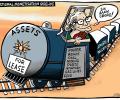
But use of that word -- privatisation -- is not encouraged. This seems to be a classic case of reforms through subtle signals, observes A K Bhattacharya.

Till such time that a new governance framework comes into being, the progress of reforms in health, education, land, labour, electricity and agriculture could remain fraught with problems, agitations and delays, observes A K Bhattacharya.
.jpg)
The Union government's offer of settling the retrospective taxation case with Cairn Energy may hinge on Vedanta withdrawing the ongoing arbitration from the Singapore Tribunal on the same issue. The government has offered to refund Cairn Energy Rs 7,900 crore that it had collected under the retrospective tax demand on fulfilment of certain conditions, including withdrawal of pending litigation and furnishing of an undertaking to the effect that no claim for cost, damages, interest, etc., would be filed. This condition is also part of the Taxation Laws (Amendment) Bill, 2021, passed by Parliament recently.
The preliminary processing of tax returns is already undertaken with the help of technology. There is now greater scope of using more technology to reduce the human interface even further, notes A K Bhattacharya.
Strengthening the portfolios of the home minister and the finance minister is a message that should not be missed, points out A K Bhattacharya.

But their trajectory and direction have been largely influenced by politics and the political leadership's understanding of how the economy needs to be managed, explains A K Bhattacharya.

More than a year of Covid-19 has pushed most businesses into gloom but Reliance Industries Ltd (RIL) managed to reduce its gross debt 25 per cent, enabling it to turn towards its next phase of capital expenditure that has come in the form of a Rs 75,000-crore plan for green energy and power storage. The company managed to stay afloat during the pandemic because of its large presence in the consumer-centric businesses of retail and telecommunication (see chart: "A new Reliance"). These two businesses constituted 45 per cent of its EBITDA during FY21 from 36 per cent in FY20.
 © 2026 Rediff.com - Advertise with us - Disclaimer - Privacy Policy - Sitemap - Feedback - About us - Terms of use - Grievances